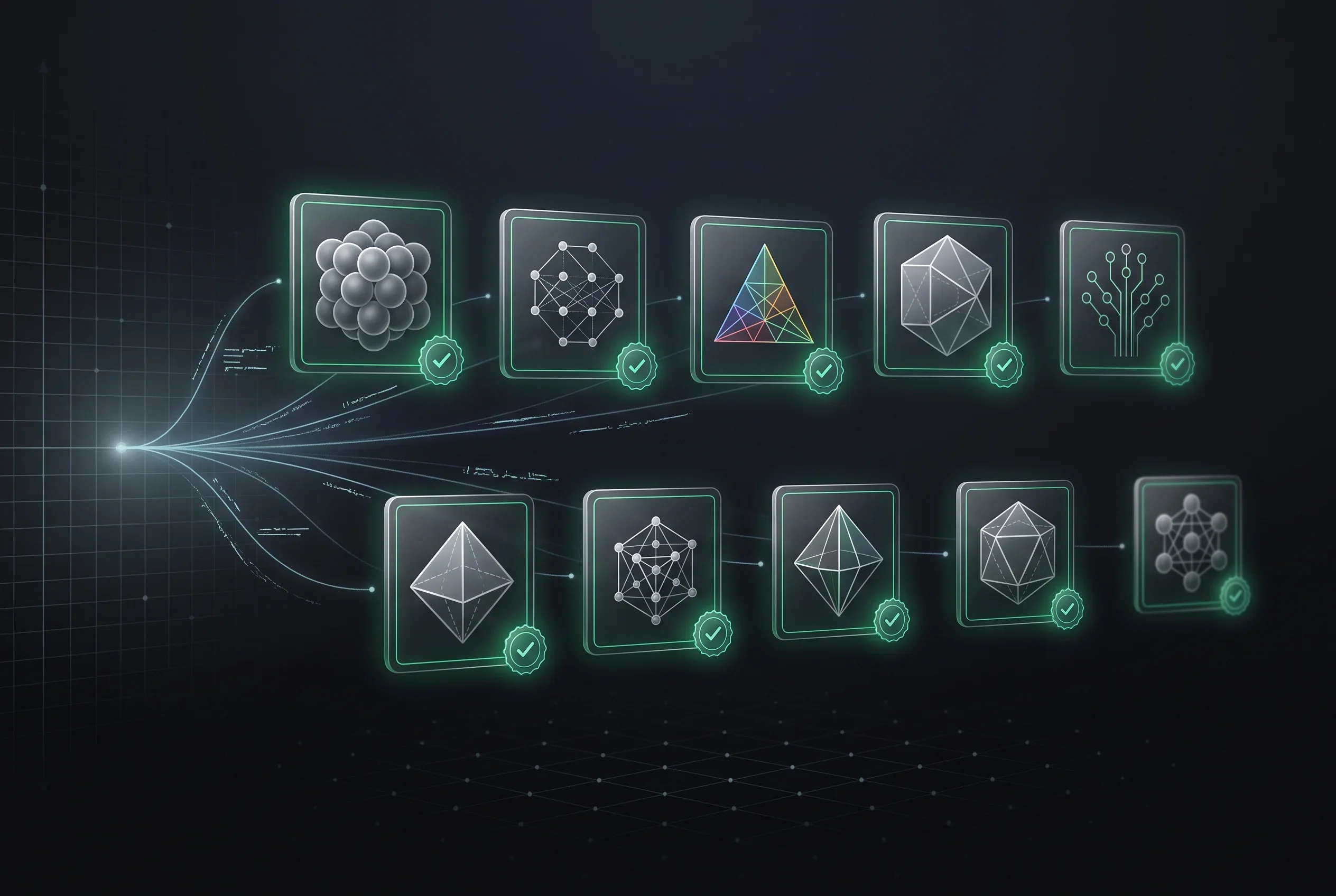
OpenAI Publishes Ten Math and TCS Results It Says Came From Astra, Its Next Major Model
On August 1, OpenAI released results for ten mathematics and theoretical computer science problems that had seen no progress on the main result for at least a decade, along with Lean 4 certificates on GitHub, reasoning walkthroughs, and a roughly $2,000 token cost at Sol API rates.
On August 1, 2026, OpenAI published new results for ten open problems in mathematics and theoretical computer science1. The company says the results were produced by an internal version of Astra, which it calls its next major model1.
By OpenAI’s account, these are problems that “have seen no progress on the main result for at least a decade, and in most cases much longer”1. They span high-dimensional geometry, coding theory, arithmetic circuit complexity, group theory, operator algebras, quantum complexity, lattice cryptography, and extremal combinatorics1.
The release includes the material for checking it
What stands out about this release is that the claims arrive with the means to inspect them. The post links to a paper PDF and a reasoning-walkthroughs PDF, and the company says it is also releasing, for each of the ten results, a narration of the model’s reasoning process1. It also placed a Lean formalization of each argument in the GitHub repository openai/ten-proofs12. The repository targets Lean 4.32.0, is licensed under Apache-2.0, and includes build instructions via Lake plus a path for third parties to verify the proofs independently2.
A proof formalized in a system like Lean returns a binary outcome: the checker either accepts it or it does not. Without engaging with the mathematics itself, anyone can mechanically confirm at least that a formal statement follows from its formal premises.
The ten results, as the company lists them1:
- High-dimensional sphere packing: new upper bounds on sphere-packing density down to the Cohn–Elkies threshold
- Binary and spherical codes: exponentially improved bounds on the maximum size of binary codes at any prescribed minimum distance, with analogous results for high-dimensional spherical codes
- Non-sofic groups: a construction establishing the existence of non-sofic groups, which the company describes as a central open question in group theory
- Connes’s rigidity conjecture: a disproof of the longstanding conjecture that certain groups are uniquely determined by their von Neumann algebras
- Arithmetic circuit complexity: new lower bounds for computing the permanent using arithmetic circuits and formulas, including an arithmetic-formula lower bound of order n^4/log n
- Quantum parallel repetition: an exponential parallel repetition theorem for general two-player quantum games
- Closest vector problem: polynomial-factor hardness of approximation for the closest vector problem, a lattice question tied to post-quantum cryptography
- Ehrhart’s volume conjecture: determining, in every dimension, the maximum volume of a convex body whose centroid is its only interior lattice point
- Multicolor Ramsey numbers: a superexponential lower bound for multicolor triangle Ramsey numbers, resolving Erdős problem 183
- Extremal number conjectures: results on the compactness and degeneracy conjectures in extremal graph theory, resolving Erdős problems 146 and 180
About $2,000 worth of tokens at Sol API rates
OpenAI also gave a cost figure. The company says the tokens needed to find these solutions “would cost roughly $2,000 at Sol API rates”1. Sol is the top-tier model left unchanged in July’s price revision, the same revision in which the smaller Luna model was cut by 80%. The figure converts the tokens spent searching for solutions into a list price; it is not the cost of the research program.
The company also drew a line around human involvement. By its account, the arguments the model produced were then prepared into manuscripts by humans using the same model, after which the model formalized each argument as a Lean certificate1. The mathematical arguments came from the model; people worked on presentation and formalization.
There is a precedent OpenAI cites: in May it published an AI-generated disproof of the Erdős unit-distance conjecture, which it says was found while evaluating an unreleased model1. In late July it announced a program giving 100,000 academic researchers free access to its frontier models, which this post references as well1. The same period has seen institutional efforts to put AI into research workflows, such as the US Department of Energy’s Genesis Mission and its first 278 selected projects.
Mathematicians put their concerns in writing in June
In this post, OpenAI expressed respect for those concerned about AI’s impact on mathematics, citing the signers of the Leiden Declaration on AI and Mathematics as an example1.
That declaration was published on June 2, 2026, has 3,365 mathematician signatories, and is endorsed by the International Mathematical Union3. It warns that AI can produce “plausible but unreliable (or even incorrect) arguments” that are hard to distinguish from valid proofs3. It also raises the problem of results announced through press releases without peer review, and the risk that commercial incentives push AI-tractable problems ahead of mathematically important ones3. It asks individual mathematicians to disclose their use of tools and retain authorial responsibility, and asks commercial AI developers to respect the values of the field3.
On authorship, OpenAI stated that attribution should honestly reflect how a result was produced, and that claiming human authorship for a proof generated entirely by an AI system would misrepresent both the system’s contribution and the nature of genuine human intellectual work1. It said it helped prepare the manuscripts and formalize the proofs in Lean and takes responsibility for their correctness, while the mathematical arguments themselves were generated by its system1. It also asked the mathematical community to engage with the results and place them in context1.
”The checker accepted it” is not the same as “the field has judged it”
Attaching Lean certificates opens the door to verification, but it does not close the mathematical question. Whether a formal statement faithfully captures the intended problem, how novel a result is against the existing literature, and what it changes about a field are all judgments that remain with mathematicians. OpenAI itself writes that it hopes the community will engage with the results and place them in context1, rather than claiming the assessment is settled.
Press coverage reports that Thomas Bloom, the University of Manchester mathematician who maintains the Erdős problems catalogue, called the results “big news”4. Meanwhile, the post says nothing about when Astra will be generally available, or about its pricing or model sizes1.
This connects to a longer-running question about how much a benchmark number actually tells you. Unlike a benchmark score, what has been published here is ten specific claims together with their formal proofs. Whether that can substitute for peer review is now a question for the mathematical community to work through.
Sources
- Ten advances in mathematics and theoretical computer science - OpenAI official announcement, August 1, 2026
- openai/ten-proofs - Official repository with the ten Lean 4 formalizations
- The Leiden Declaration on AI and Mathematics - Published June 2, 2026; 3,365 signatories; endorsed by the IMU
- OpenAI announces its “next major model” Astra by dropping ten previously unsolved math solutions - The Decoder, August 1, 2026
Was this article helpful?
Thank you!
Received. Thank you!