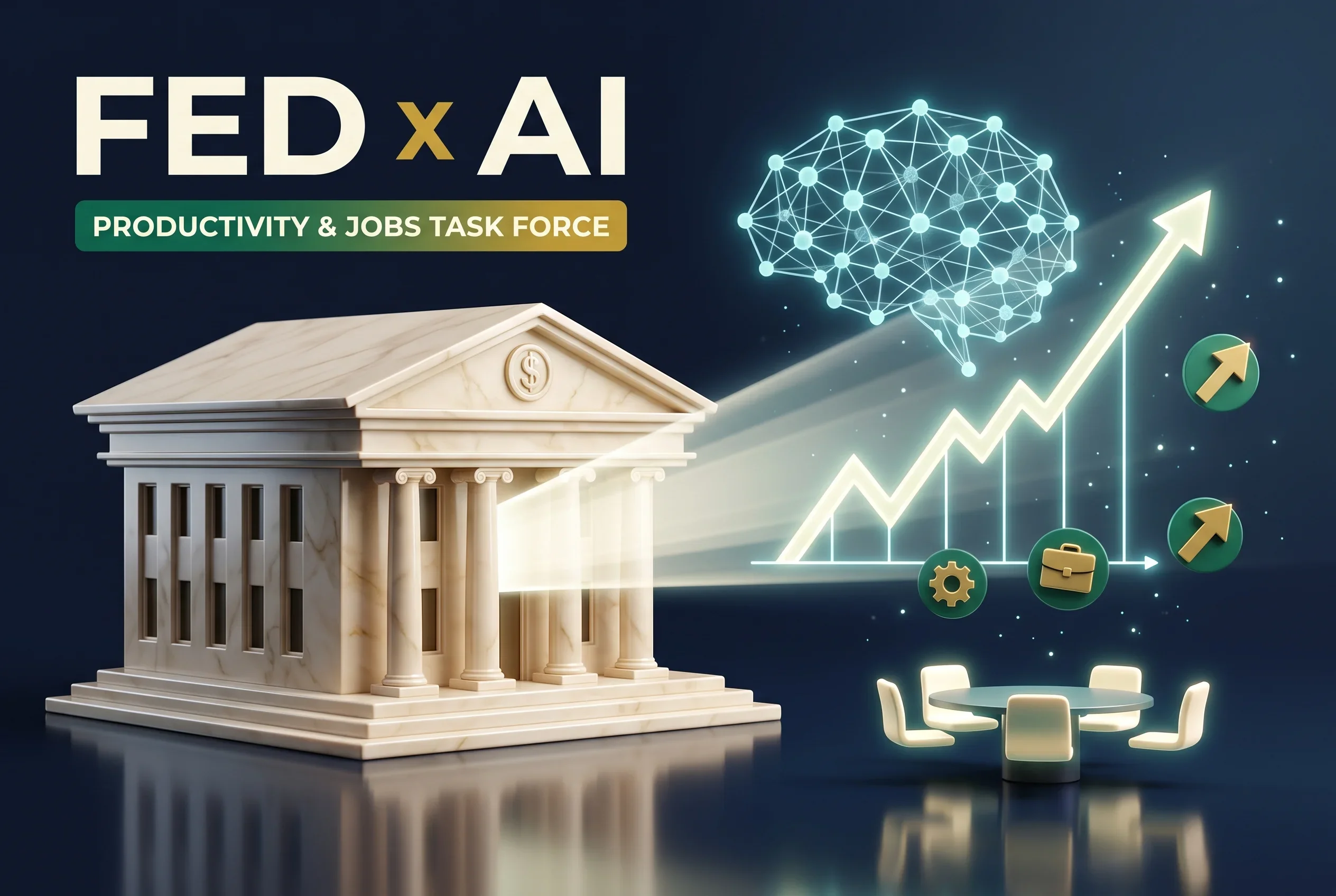
Fed Creates AI Task Force Co-Led by Marc Andreessen to Assess Economic Impact
The Federal Reserve announced five monetary policy task forces on July 9, 2026. The Productivity and Jobs group - co-led by a16z's Marc Andreessen, Stanford economist Charles I. Jones, and Microsoft's Asha Sharma - will assess the economic impact of AI and other general-purpose technologies.
The Federal Reserve announced on July 9, 2026 the leadership and objectives of five task forces set up to review how it conducts monetary policy1. Among them, the Productivity and Jobs task force is charged with assessing “the economic impact of new general-purpose technologies, including artificial intelligence, to inform the Federal Reserve’s policy judgments”1. It is co-led by Marc Andreessen, cofounder and general partner of venture capital firm Andreessen Horowitz (a16z); Charles I. Jones, professor of economics at Stanford University; and Asha Sharma, Microsoft executive vice president and XBOX CEO1.
It is unusual for a central bank to formally stand up a body dedicated to evaluating AI’s economic effects with industry insiders at the table. The task forces are reportedly expected to recommend policy changes to the Fed by the end of the year3.
AI Named Explicitly in One of Five Task Forces
The five task forces cover Communications, Balance Sheet Policy, Data, Productivity and Jobs, and Inflation Frameworks1. Each is co-led by outside economists, business leaders, and former central bank practitioners, supported by Fed staff13.
The Productivity and Jobs group is the one that names AI directly: its formal charge is to assess the economic impact of new general-purpose technologies, including artificial intelligence, to inform the Fed’s policy judgments1. Chair Kevin Warsh described its work as surveying “the pace, the reach, [and] the economic impact of new general-purpose technologies, including AI”2.
The composition stands out. Andreessen co-founded a VC firm that invests heavily in AI startups, and Sharma is a sitting Microsoft executive - two industry insiders on a Fed advisory body1. Jones, the academic on the panel, is a Stanford economist known for his work on economic growth, currently on leave at Anthropic2. Other task forces also feature prominent names: economist Raj Chetty on Data, former Fed Governor Jeremy Stein and former Reserve Bank of India Governor Raghuram Rajan on Balance Sheet Policy3.
A Generational Review Under Warsh
Chair Warsh had signaled on June 17 that he would appoint five task forces on matters he called “timely, consequential, and, in my view, worthy of a fresh look”4; this announcement fills in the members and objectives. In the release, Warsh said “The Federal Reserve’s commitment to price stability and maximum employment is unwavering,” adding that “The U.S. economy has changed significantly over the last generation, and never more so than right now”1.
AI’s impact on jobs and productivity has been debated for years - the World Economic Forum estimated 85 million jobs would be affected - but much of that discussion has lived in think-tank reports and consulting forecasts. This move means the question is now formally embedded in the monetary policy process.
AI’s Economic Effect Becomes a Policy Variable
The practical significance is that how AI’s productivity effect gets measured will feed into decisions about interest rates and employment policy. If AI-driven productivity gains are real, that supports a view of higher economic supply capacity and softer inflation pressure; if the gains prove limited, views on the sustainability of massive AI-related investment could shift. The task force’s assessments are likely to become baseline inputs for those judgments.
For business readers, this is another sign that AI adoption has become a macroeconomic question rather than just a firm-level efficiency play - Microsoft is spending $2.5 billion on enterprise AI deployment, for example. At the same time, having industry insiders co-lead the assessment leaves room for debate about neutrality. The recommendations expected by year-end3 will show how the Fed intends to measure AI’s economic effect and how much weight to give it. The task force’s activities are published on the Fed’s official site, making it a useful fixed point for tracking the AI-and-economy debate.
Sources
- Federal Reserve announces the leadership and objectives of its task forces to advance the conduct of monetary policy - Federal Reserve press release (July 9, 2026)
- Chairman’s Task Forces for Advancing Monetary Policy: Productivity and Jobs - Federal Reserve official site
- Fed announces membership of monetary policy task forces - American Banker (July 9, 2026)
- Fed Chair Kevin Warsh Recruits Experts to Rethink Fed Methods - PYMNTS
Was this article helpful?
Thank you!
Received. Thank you!