LLMs Create Virtual Cities: Woven by Toyota's New Paper 'CitySim' Realizes Urban Simulation
CitySim, announced by Woven by Toyota's research team, is a groundbreaking simulation framework that uses large language models to realistically reproduce people's behavior in cities. Applications for urban planning and social research are expected.
What if AI could simulate complex human behavior in cities? The paper “CitySim: Modeling Urban Behaviors and City Dynamics with Large-Scale LLM-Driven Agent Simulation”1 published by Woven by Toyota’s research team is a groundbreaking research achievement that answers precisely this question.
New Horizons in Urban Simulation
Accurately modeling people’s behavior has been a long-standing challenge in urban planning and social research. Traditional simulations reproduced people’s movements based on predetermined rules, but this approach couldn’t express the complex and adaptive decision-making processes that humans possess.
CitySim1 breaks through these limitations using the power of large language models (LLMs). Research leaders Nicolas Bougie and Narimasa Watanabe succeeded in creating agents that make more human-like, context-aware decisions by leveraging LLMs.
CitySim’s Innovative Architecture
CitySim’s most distinctive feature is the advanced cognitive functions possessed by each agent (virtual citizen).
1. Detailed Cognitive State Representation
Each agent has the following elements:
Dynamic Memory Modules
- Spatial memory: Where they went, what they saw
- Temporal memory: When they did what
- Social memory: Who they met and what interactions they had
Belief and Needs Tracking
- Beliefs about each location (e.g., “That restaurant is crowded”)
- Changes in basic needs (eating, sleeping, socializing, etc.)
Long-term Goal Formation
- Setting not just daily activities but also long-term goals
- Adaptive planning for achieving goals
2. Recursive Value-Driven Activity Planning
At the core of CitySim is “recursive value-driven activity planning.” This is a mechanism where agents comprehensively consider their needs, beliefs, and goals to decide their next action.
For example, when an agent feels “hungry”:
- Recall nearby restaurants (spatial memory)
- Check beliefs about each restaurant (“Restaurant A is delicious but expensive,” “Restaurant B is cheap but far”)
- Consider current situation (time, money, other plans)
- Choose the option with the highest value
This process is handled in natural language by the LLM, enabling decision-making closer to human behavior.
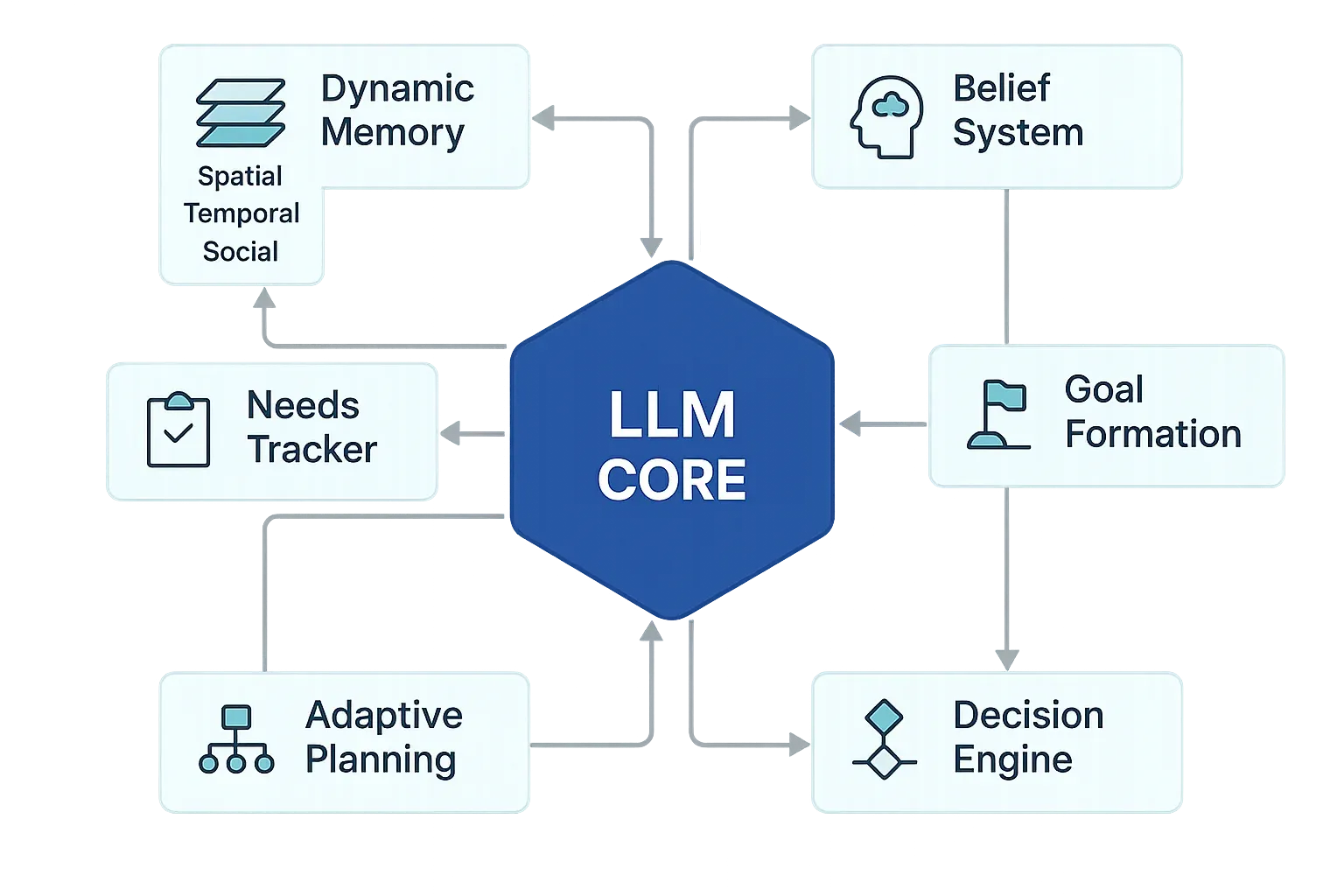 Image is an AI-generated illustration for explanatory purposes
Remarkable Experimental Results
The research team conducted large-scale urban simulations using CitySim and compared the results with real-world data.
Macro-level Behavior Patterns
One of the most impressive results was the reproducibility of time-use distribution. The way CitySim agents spent their day (work, sleep, leisure, etc.) matched national statistical survey data remarkably well1.
Movement Patterns and Location Popularity
Agent movement patterns were also realistic:
- Reproduction of morning and evening rush hours
- Differences between weekend and weekday movement patterns
- Concentration and dispersion to popular spots
Particularly interesting was that agents spontaneously generated realistic behavior patterns even though researchers had not intentionally programmed them.
Social Interactions and Well-being
CitySim is not just a movement simulation. Social interactions between agents are also modeled:
- Formation and maintenance of friendships
- Group activities
- Effects of isolation and social connections on well-being
These elements also showed results consistent with patterns known in sociological research.
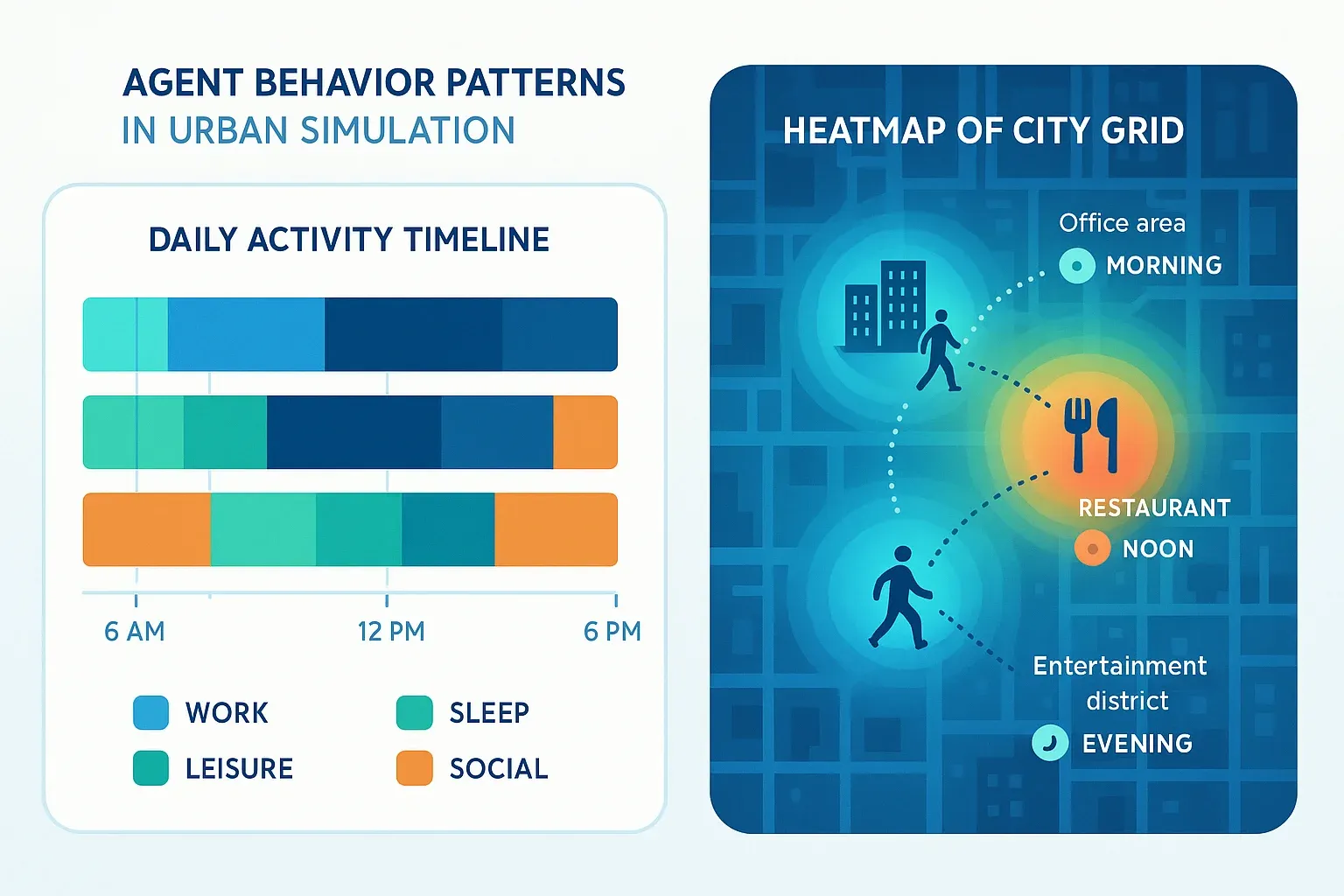 Image is an AI-generated illustration for explanatory purposes
Technical Contributions and Application Potential
Major Technical Innovations
- Scalability: Can simulate thousands of agents simultaneously
- Adaptability: Agents learn from experience and change behavior
- Interpretability: LLM-based, so agent decision-making processes can be explained in natural language
Potential Application Areas
Urban Planning
- Impact assessment of new transportation systems
- Optimal placement of commercial facilities
- Disaster evacuation simulations
Social Research
- Predicting effects of policy changes
- Measuring effectiveness of social interventions
- Simulating demographic changes
Business Applications
- Store location optimization
- Marketing strategy validation
- Service demand forecasting
Challenges and Future Prospects
While CitySim has shown groundbreaking results, researchers also recognize the following challenges:
1. Inheriting LLM Biases
LLMs may have learned biases from training data, which could affect simulation results. The research team is exploring ways to achieve fairer and more representative simulations.
2. Optimizing Computational Costs
Running LLMs for thousands of agents consumes significant computational resources. Developing more efficient architectures is a future challenge.
3. Difficulty in Validation
Human behavior inherently contains unpredictable elements, making it difficult to fully validate the “accuracy” of simulations.
The Future City Envisioned by Woven by Toyota
It’s no coincidence that this research was published by Woven by Toyota. The company is building an experimental city called “Woven City” in Susono City, Shizuoka Prefecture, and technologies like CitySim may be utilized in actual urban design.
CitySim represents an important step toward realizing “cognitive digital twins” that take urban simulation as digital twins one step further, modeling even individual residents’ behaviors and emotions.
Academic Significance and Future Research
This paper is an important achievement that pushes the boundaries between AI research and urban science. It is particularly valuable academically in the following ways:
- Interdisciplinary Approach: Integrating AI, urban planning, sociology, and psychology
- New Methodology: Pioneering example of applying LLMs to social simulation
- Open Discussion: Frankly acknowledging research limitations and showing paths for improvement
Future expectations include verification in more diverse urban environments, exploring applicability in different cultural spheres, and extension to real-time simulation.
This research from Woven by Toyota symbolizes that mobility companies have entered an era of considering entire urban ecosystems. If CitySim technology matures, it may enable more human-centered urban design, more effective policy-making, and deeper social understanding. We look forward to seeing how such technologies will transform our urban lives.
Sources
- CitySim: Modeling Urban Behaviors and City Dynamics with Large-Scale LLM-Driven Agent Simulation - arXiv paper (by Nicolas Bougie, Narimasa Watanabe, Woven by Toyota)
Was this article helpful?
Thank you!
Received. Thank you!