Apple Silicon vs NVIDIA Memory Bandwidth: M1 to M6 and RTX 4090/5090 Compared
Compare memory bandwidth across Apple M1 through M6 and M5 Ultra and NVIDIA RTX 4090/5090, with exact GB/s figures for Pro, Max, and Ultra variants plus unified memory vs dedicated VRAM.
In AI processing and creative work, a chip’s memory bandwidth is a decisive factor for performance. Memory bandwidth measures how fast data moves between the processor and memory, and high bandwidth pays off in workloads that handle large volumes of data.
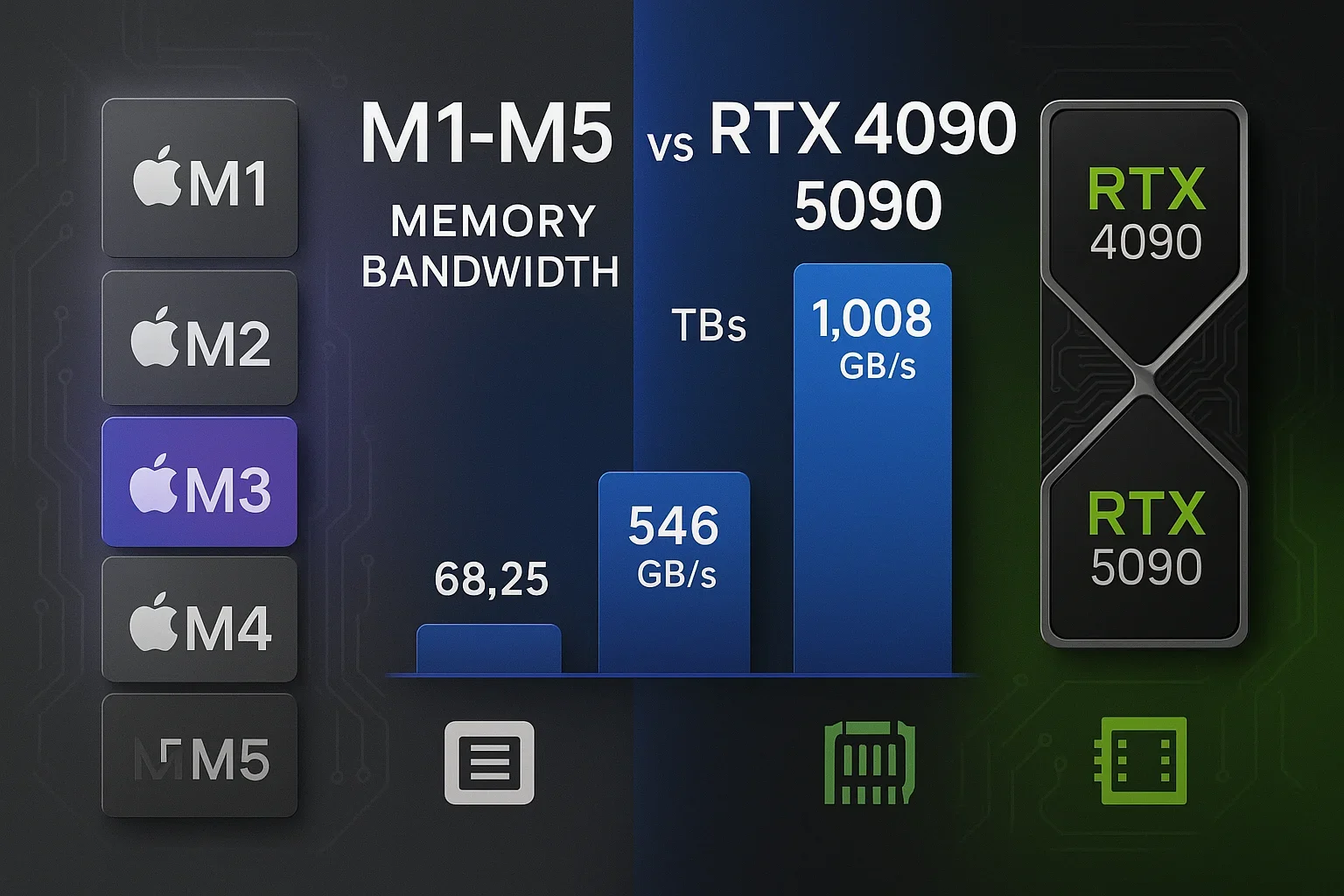
This article compares the memory bandwidth of each Apple Silicon generation from M1 to M6 against NVIDIA’s GeForce RTX 4090/5090, and explains the architectural characteristics of each. It clarifies how two different approaches—Apple’s unified memory architecture and NVIDIA’s dedicated GDDR6X/GDDR7 memory—translate into different performance profiles.
The Evolution of Apple Silicon Memory Bandwidth
The M1 Generation (2020)
Apple Silicon’s M1 generation is the first generation of Apple’s in-house ARM-based chips. The M1 series adopts a unified memory architecture in which the CPU and GPU can access the same memory pool, reducing memory-copy overhead.
| Chip | Memory Bandwidth | Memory Capacity |
|---|---|---|
| M1 | 68.25 GB/s1 | Up to 16GB |
| M1 Pro | 200 GB/s2 | Up to 32GB |
| M1 Max | 400 GB/s2 | Up to 64GB |
| M1 Ultra | 800 GB/s2 | Up to 128GB |
The M1 Ultra achieves 800 GB/s of bandwidth by connecting two M1 Max chips through Apple’s proprietary UltraFusion interconnect.
The M2 Generation (2022)
The M2 generation improved performance over the M1 while also enhancing power efficiency.
| Chip | Memory Bandwidth | Memory Capacity |
|---|---|---|
| M2 | 100 GB/s3 | Up to 24GB |
| M2 Pro | 200 GB/s4 | Up to 32GB |
| M2 Max | 400 GB/s4 | Up to 96GB |
| M2 Ultra | 800 GB/s4 | Up to 192GB |
The base M2 model rose from the M1’s 68.25 GB/s to 100 GB/s, an increase of roughly 50%3. The M2 Pro and M2 Max each retain the same bandwidth as their M1-generation counterparts.
The M3 Generation (2023)
In the M3 generation, the manufacturing process was refined to 3nm and a new GPU architecture was introduced. However, the reduction in the M3 Pro’s memory bandwidth sparked controversy.
| Chip | Memory Bandwidth | Memory Capacity |
|---|---|---|
| M3 | 100 GB/s13 | Up to 24GB |
| M3 Pro | 150 GB/s5 | Up to 36GB |
| M3 Max | 300-400 GB/s5 | Up to 128GB |
| M3 Ultra | 819 GB/s14 | Up to 512GB16 (current Mac Studio tops out at 256GB14) |
The M3 Pro dropped 25%, from the 200 GB/s of the M1 Pro and M2 Pro down to 150 GB/s5. This was due to the adoption of a 192-bit memory bus, a design change reportedly aimed at cost reduction. The M3 Max comes in two variants: the 14-core CPU / 30-core GPU version delivers 300 GB/s, while the full version delivers 400 GB/s.
The M4 Generation (2024)
The M4 generation substantially recovered the memory bandwidth that had been cut in the M3 Pro.
| Chip | Memory Bandwidth | Memory Capacity |
|---|---|---|
| M4 | 120 GB/s6 | Up to 32GB |
| M4 Pro | 273 GB/s6 | Up to 64GB15 |
| M4 Max | 546 GB/s7 | Up to 128GB |
The M4 Pro reaches 273 GB/s, which Apple describes as “a massive 75 percent increase over M3 Pro”15. The M4 Max hits 546 GB/s, a 36.5% increase over the full version of the M3 Max (400 GB/s).
The M5 Generation (2025)
Announced in October 2025, the M5 was the latest generation of Apple Silicon at the time.
| Chip | Memory Bandwidth | Memory Capacity |
|---|---|---|
| M5 | 153 GB/s8 | Up to 32GB |
| M5 Pro | Up to 307 GB/s12 | Up to 64GB12 |
| M5 Max | Up to 614 GB/s12 | Up to 128GB12 |
The M5 carries 153 GB/s of memory bandwidth, up about 27.5% from the M4’s 120 GB/s8. The higher-end parts were announced on March 3, 2026, with Apple stating that “M5 Pro supports up to 64GB of unified memory with up to 307GB/s of memory bandwidth, while M5 Max supports up to 128GB of unified memory with up to 614GB/s of memory bandwidth”12. Compared with the M1’s 68.25 GB/s, that is more than double the performance.
M6 and M5 Ultra Generation (2026)
Apple announced the M6 and M5 Ultra on August 25, 202611. The M6 is the company’s first chip on a 2nm process.
| Chip | Memory Bandwidth | Memory Capacity |
|---|---|---|
| M6 | Up to 170 GB/s11 | — |
| M5 Ultra | 1.2 TB/s11 | Up to 512GB11 |
Apple’s announcement describes the M6’s “up to 170GB/s” as a 10 percent increase over the M5 and a 2.5x increase over the M111. Set against the earlier steps in this article — M4 to M5 (120 to 153 GB/s, about 27.5%) or M3 Pro to M4 Pro (150 to 273 GB/s, 82%) — this is a modest update on the bandwidth axis.
The M5 Ultra, by contrast, reaches 1.2 TB/s, which Apple describes as 50 percent higher than the M3 Ultra11. Memory capacity tops out at 512GB11 — the same ceiling the M3 Ultra had at announcement16. What moved is bandwidth; the spec-level capacity limit stayed put. For running large models locally, where both bandwidth and capacity matter, the Ultra line continues to be the part that carries that role.
Memory Bandwidth of the NVIDIA GeForce RTX Series
NVIDIA’s GeForce RTX series comprises high-end GPUs aimed at gaming and creators. The RTX 40 series and the latest 50 series pack dedicated GDDR memory and deliver extremely high memory bandwidth.
RTX 4090 (2022)
The RTX 4090 is the flagship model built on the Ada Lovelace architecture.
| Item | Specification |
|---|---|
| Memory Bandwidth | 1,008 GB/s (1.01 TB/s)9 |
| Memory Capacity | 24 GB |
| Memory Type | GDDR6X |
| Memory Bus Width | 384-bit9 |
| Memory Clock | 1313 MHz (21 Gbps effective)9 |
The RTX 4090’s 1,008 GB/s exceeds the M1 Ultra (800 GB/s) and the M3 Ultra (819 GB/s)14. The M5 Ultra announced in August 2026 (1.2 TB/s) surpasses it, however, so the gap against Apple Silicon’s upper tier has narrowed with each generation11.
RTX 5090 (2025)
The RTX 5090 is the latest-generation flagship GPU built on the Blackwell architecture. It was announced at CES in January 202510.
| Item | Specification |
|---|---|
| Memory Bandwidth | 1,792 GB/s10 |
| Memory Capacity | 32 GB |
| Memory Type | GDDR710 |
| Memory Bus Width | 512-bit10 |
| Memory Clock | 28 Gbps10 |
The RTX 5090’s memory bandwidth is 78% higher than the RTX 4090’s 1,008 GB/s10, thanks to next-generation GDDR7 memory and a 512-bit bus. That bandwidth is 3.3 times that of the M4 Max (546 GB/s) and about 2.9 times the M5 Max (up to 614 GB/s)12. Against the highest Apple Silicon figure, the M5 Ultra’s 1.2 TB/s, it is about 1.5 times, so the dedicated GPU retains its lead11.
Architectural Differences and Use-Case Comparison
Unified Memory vs. Dedicated VRAM
There is a fundamental difference between the memory architectures of Apple Silicon and NVIDIA GPUs.
Apple’s unified memory has the CPU and GPU share the same memory pool. This eliminates memory-copy overhead and improves memory efficiency. For example, on a Mac with 32GB of unified memory, the application and the GPU share the same memory, which simplifies memory management.
NVIDIA’s dedicated VRAM is memory reserved for the GPU. It is allocated separately from system memory and optimized for GPU processing. The RTX 5090’s 32GB of memory is used exclusively by the GPU, separate from system memory.
When Bandwidth Matters Most
The scenarios where memory bandwidth is critical include the following.
3D rendering and video editing require large volumes of texture and frame data to be transferred at high speed. The RTX 5090’s 1,792 GB/s shines in 8K video editing and real-time rendering of complex 3D scenes.
AI and machine learning demand high bandwidth for training and inference on large models. NVIDIA’s RTX series delivers excellent performance on deep-learning tasks through the combination of dedicated Tensor cores and high-bandwidth memory.
General development work favors Apple Silicon’s unified memory. With no memory-copy overhead, data sharing between the CPU and GPU is efficient. The M6’s up to 170 GB/s is more than enough for everyday development tasks, web browsing, and document work11.
Generational Trends
Apple Silicon’s Strategy
Apple cut memory bandwidth on the M3 Pro but substantially improved it in the M4 generation. This is likely the result of rebalancing cost and performance. The M4 Pro delivered a 75 percent bandwidth increase over the M3 Pro in Apple’s wording15, and the M4 Max reached 546 GB/s, meeting the needs of professional users.
In the M5 generation, Apple raised the base model’s bandwidth to 153 GB/s. The M6 that followed reaches up to 170 GB/s, a modest 10 percent step up from the M511. The phase of moving base-model bandwidth sharply has settled, with the gains directed instead at the Ultra tier (1.2 TB/s and up to 512GB on the M5 Ultra)11.
NVIDIA’s Evolution
As NVIDIA moved from the RTX 4090 to the RTX 5090, it substantially advanced its memory technology. The shift from GDDR6X to GDDR7 and the expansion of the bus width from 384-bit to 512-bit produced a 78% increase in bandwidth.
This evolution strengthens support for compute-intensive workloads such as AI inference and ray tracing.
Performance Comparison Summary
The highest-bandwidth Apple Silicon part is the M5 Ultra announced in August 2026 at 1.2 TB/s; among single-chip Max-class parts it is the M5 Max announced in March 2026 at up to 614 GB/s1112. Either is remarkably high for an integrated system. NVIDIA’s RTX 5090, meanwhile, still delivers the highest figure here at 1,792 GB/s as a dedicated GPU.
Their strengths differ. Apple Silicon excels in power efficiency and system integration, making it well suited to mobile devices and all-in-one systems. NVIDIA’s RTX series is ideal for professional workstations and gaming PCs that demand maximum performance.
Choosing the right option for the job maximizes both work efficiency and return on investment. For general development work and content creation, Apple Silicon is a strong fit; for heavy 3D rendering and large-scale AI training, NVIDIA GPUs are the better choice.
The evolution of these chips is likely to continue alongside future gains in hardware performance. Ongoing innovation from each company should bring even higher bandwidth and efficiency.
Sources
- Apple M1 - Wikipedia - Technical specifications of the M1 series
- Apple M1 - Memory bandwidth of the M1 Pro, Max, and Ultra
- Apple Chip Comparison (October 2025) M1 vs M2 vs M3 vs M4 Complete Guide - Bandwidth of the M2 series
- Apple Chip Comparison - Specifications of the M2 Pro, Max, and Ultra
- Apple M3 Pro Chip Has 25% Less Memory Bandwidth Than M1/M2 Pro - MacRumors, on the M3 Pro’s reduced bandwidth
- Apple M4 (+ Pro / Max) vs M3 (+ Pro / Max / Ultra) vs M2 (+ Pro / Max / Ultra) vs M1 (+ Pro / Max / Ultra) - Bandwidth of the M4 and M4 Pro
- Mac Studio - Apple official, specifications of the M4 Max
- Apple unleashes M5, the next big leap in AI performance for Apple silicon - Apple official, the M5 announcement
- NVIDIA GeForce RTX 4090 Specs - TechPowerUp, detailed specifications of the RTX 4090
- NVIDIA GeForce RTX 5090 Specs: Everything You Need to Know - Vast.ai, specifications of the RTX 5090
- Apple introduces M6 and M5 Ultra for a big leap in performance and AI compute - Apple official, M6 and M5 Ultra announcement (August 25, 2026)
- Apple introduces MacBook Pro with all-new M5 Pro and M5 Max - Apple official, M5 Pro and M5 Max announcement (March 3, 2026)
- MacBook Air (13-inch, M3, 2024) - Technical Specifications - Apple official specs, M3 memory bandwidth
- Mac Studio (2025) - Technical Specifications - Apple official specs, M3 Ultra memory bandwidth and capacity
- Apple introduces M4 Pro and M4 Max - Apple official, M4 Pro and M4 Max announcement (October 2024)
- Apple reveals M3 Ultra, taking Apple silicon to a new extreme - Apple official, M3 Ultra announcement (unified memory ceiling)
Was this article helpful?
Thank you!
Received. Thank you!