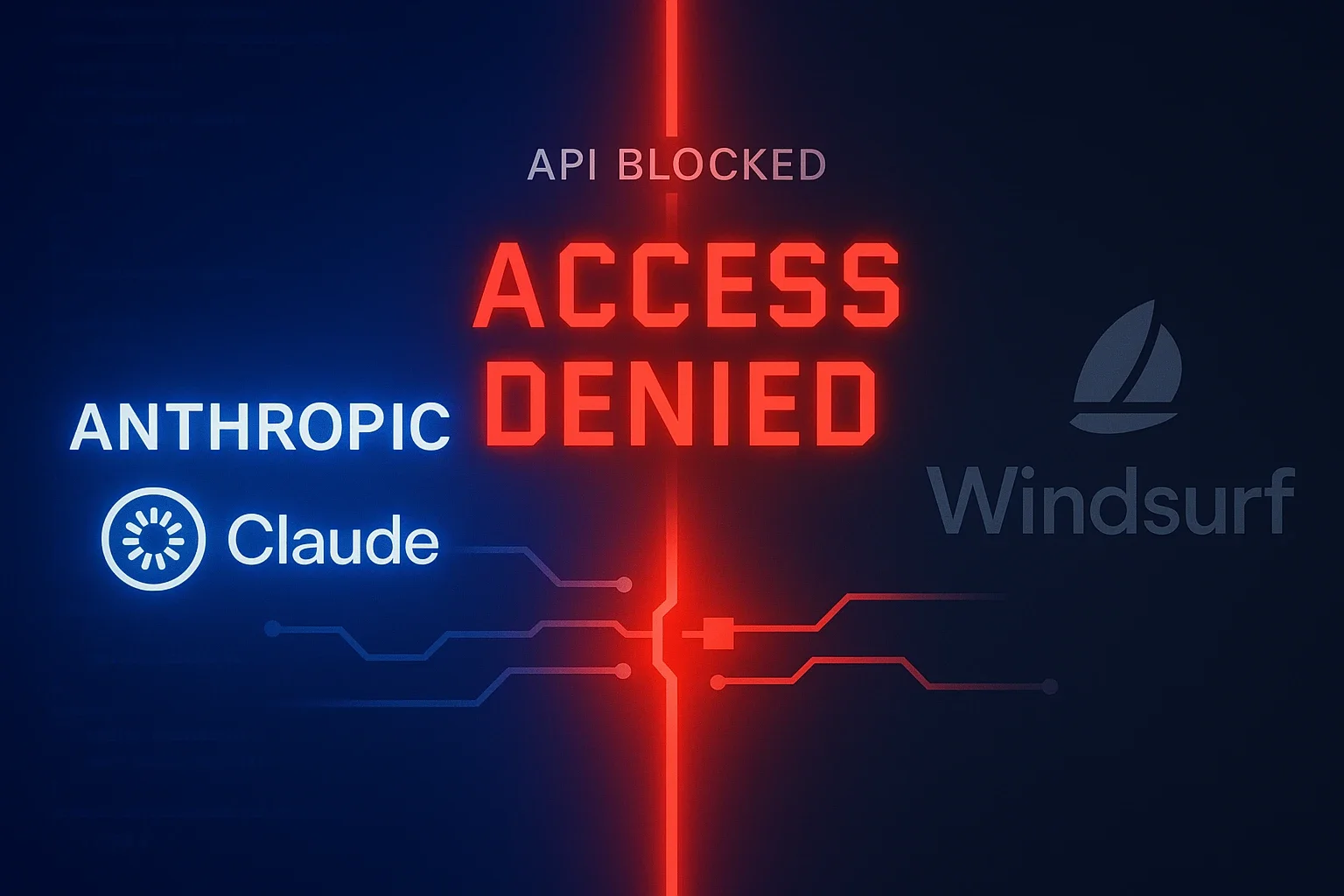
Anthropic blocks Windsurf's Claude API access amid OpenAI acquisition rumors
Anthropic restricts AI code editor Windsurf's direct access to Claude API. The move comes against the backdrop of rumors about OpenAI's $3 billion acquisition of Windsurf, highlighting intensifying competition in the AI industry.
As competition in the AI industry intensifies, Anthropic has made an important strategic decision regarding technology provision to competitors. On June 3, 2025, the company announced restrictions on AI code editor “Windsurf’s” direct API access to Claude AI models. This decision was influenced by Bloomberg’s report about the possibility of OpenAI acquiring Windsurf for $3 billion1.
Anthropic co-founder and Chief Science Officer Jared Kaplan candidly stated in a TechCrunch interview about this decision: “I think it would be odd for us to sell Claude to OpenAI”2. The company almost completely blocked first-party access to Claude 3.x models, including Claude 3.5 Sonnet and 3.7 Sonnet, with just five days’ notice3.
What is Windsurf
Windsurf is a rapidly growing development tool as an AI-driven code editor. Its main feature includes an advanced AI agent function called Cascade, which has the ability to independently handle complex coding tasks4.
Key features of Windsurf
The platform provides advanced features including multi-file editing, automatic error correction, and visual development assistance. Cascade in particular can understand the context of the entire codebase and track developers’ work history and even clipboard contents to make more intelligent suggestions. It also includes functionality to upload images and generate HTML, CSS, and JavaScript code, significantly simplifying the transition from design to implementation.
The pricing structure starts with a free plan, with the Pro version ($15/month) offering 500 user prompts and 1,500 flow actions, and the Enterprise version (starting at $60/month per user) providing advanced organizational features.
Impact of API access restrictions
The restrictions have affected Windsurf users in several ways. First, direct access to Claude 3.5 and 3.7 Sonnet models has been lost, causing temporary service availability issues. As a short-term solution, Windsurf offers a “bring your own key” approach where users can connect their own Anthropic API keys to their accounts, but this is more expensive than usual and more complex to set up3.
Furthermore, even on Claude 4’s launch day, Windsurf did not receive direct access from Anthropic, and this situation continues. These restrictions have forced some users to migrate to competing services like Cursor.
Anthropic’s strategic decision
Kaplan cited three main reasons for this decision. First, rumors and reports of acquisition by OpenAI. Second, the need to efficiently allocate limited computing resources. Third, focus on sustainable partnerships that can collaborate long-term2.
Interestingly, Anthropic explicitly stated that it will continue its collaborative relationship with Cursor, which is backed by OpenAI. Kaplan stated “we expect to continue working with Cursor for a long time,” suggesting that Anthropic is not simply excluding competitor tools.
Intensifying competition in AI development tools market
This move reflects intensifying competition in the AI development tools market. Anthropic announced its own AI coding application “Claude Code” and held its first “Code with Claude” developer conference on May 22-231. The company criticizes static AI chatbot platforms and focuses on developing more agent-type products.
Anthropic spokesperson Steve Mnich explained: “We are prioritizing capacity for sustainable partnerships that can effectively serve the broader developer community”3.
Implications for Japan’s AI development market
This case contains important lessons for Japanese AI development companies. First, it highlights the importance of strategic partnerships beyond mere technology use in building relationships with AI technology providers. Particularly, it became clear that when there’s a possibility of acquisition by competitors, there’s a risk that technology access may suddenly be restricted.
When Japanese companies select AI development tools, they need to consider not only technical superiority but also providers’ long-term strategies and competitive relationships. Additionally, it’s important to maintain relationships with multiple AI model providers and appropriately manage dependency on specific services.
Furthermore, for companies developing their own AI tools, this serves as a case study demonstrating the importance of building proprietary ecosystems. Just as Anthropic developed Claude Code, companies with core AI technology can enhance their market competitiveness by building their own tools and platforms that leverage that technology.
Developers and AI-related companies need to closely monitor such market trends and build sustainable development environments while appropriately managing technology dependency risks.
Sources
- Anthropic co-founder on cutting access to Windsurf: ‘It would be odd for us to sell Claude to OpenAI’ - TechCrunch article (June 5, 2025)
- Windsurf says Anthropic is limiting its direct access to Claude AI models - TechCrunch article (June 3, 2025)
- OpenAI Rival Anthropic Blocks Windsurf from Using Claude 4 Models - Analytics India Magazine
- Windsurf Editor - Windsurf Official Website
Was this article helpful?
Thank you!
Received. Thank you!