NVIDIA Invests $3.5B in MediaTek Convertible Bonds, Pulling Custom AI Chips Into NVLink
NVIDIA and MediaTek announced an expanded collaboration on August 31, 2026 across AI infrastructure, local AI computing and automotive. MediaTek will adopt NVLink Fusion to give customers a prevalidated path for custom XPUs into NVIDIA rack-scale systems.
NVIDIA and MediaTek announced on August 31, 2026 that they are deepening their longstanding collaboration across three areas — AI infrastructure, local AI computing, and automotive1. The announcement also disclosed that NVIDIA has invested $3.5 billion in convertible bonds issued by MediaTek1.
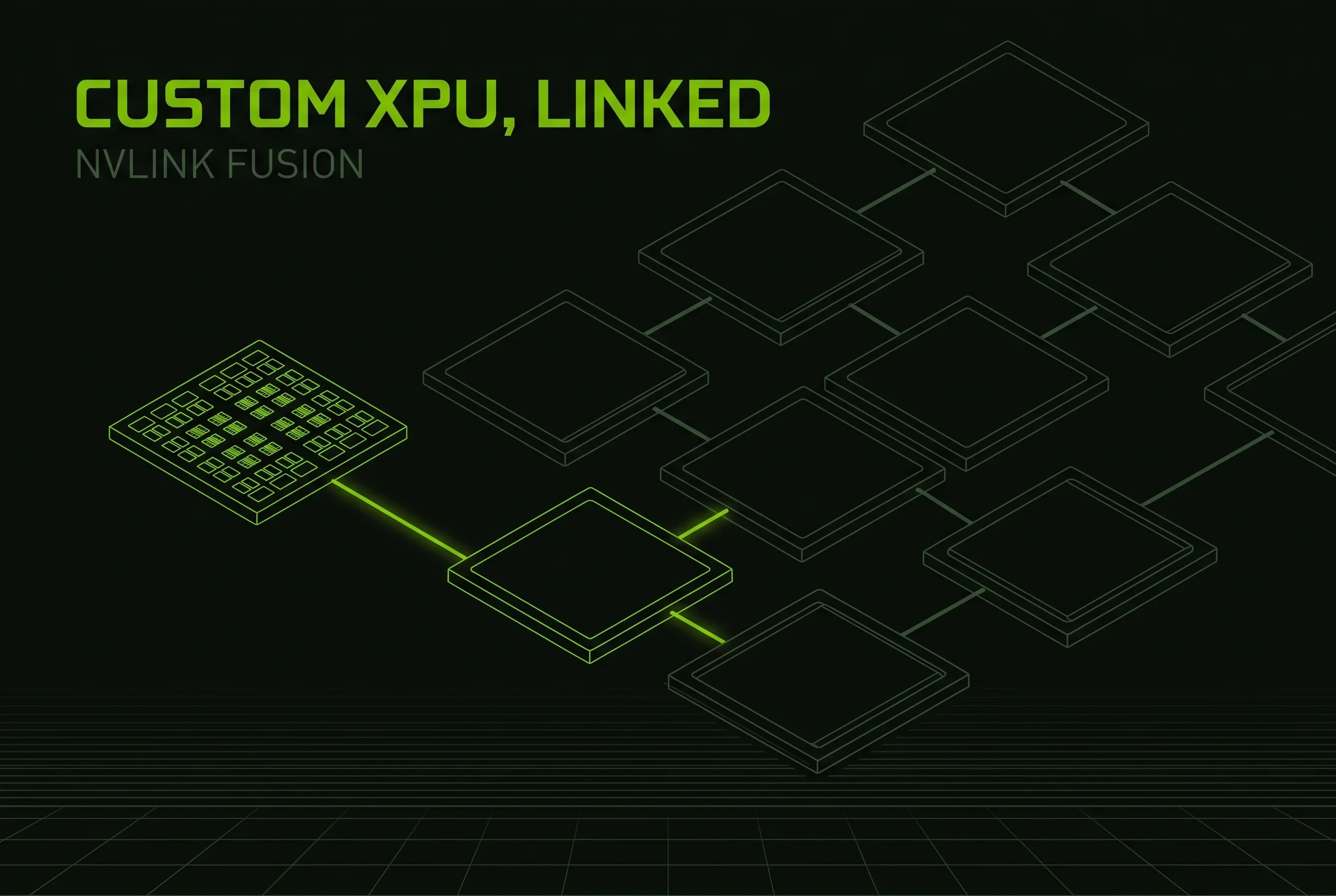
The first item listed under the expanded collaboration is MediaTek’s adoption of the NVIDIA NVLink Fusion platform1. The stated purpose is to give hyperscalers, cloud service providers, and frontier model developers a prevalidated path to develop custom XPUs and bring them into NVIDIA NVLink-connected, rack-scale AI factories1.
Absorbing Chips That Could Compete, by Becoming the Connector
Custom XPUs — the AI accelerators customers design themselves — are the kind of silicon that could displace NVIDIA GPUs. What this announcement sets out is not to keep them out but to have them run on NVIDIA’s fabric.
The release frames it this way: building a custom accelerator is only the beginning of deploying custom XPUs in rack-scale AI factories. Integrating multi-die architectures, advanced packaging, high-speed SerDes, HBM, I/O, and scale-up networking into a manufacturable, production-ready system requires extensive chip-to-rack engineering, qualification, and supply-chain support1.
NVLink Fusion is positioned as a prebuilt, prequalified, and system-prevalidated foundation for multi-die XPU development1. Rather than engineering and qualifying every element surrounding a custom XPU from the ground up, customers can focus resources on the differentiated compute that defines their platforms while relying on NVIDIA and MediaTek for NVLink connectivity, memory architecture, packaging, manufacturing, and rack-scale technologies1. Customers can bring their XPU designs to MediaTek and tailor connectivity, memory, packaging, performance, and power characteristics to their workloads and infrastructure requirements1.
Three technologies are named as what the NVLink Fusion platform brings together1:
- NVIDIA NVLink Fusion chiplet — connects XPUs to the NVIDIA NVLink scale-up fabric using NVIDIA photonics or electrical interconnects
- NVIDIA NVLink-C2C — provides high-bandwidth, energy-efficient connectivity between XPUs, NVIDIA Rosa CPUs, and other compatible processors
- NVIDIA NVHBM — integrates customized memory capabilities to increase bandwidth and energy efficiency while dedicating more silicon area to compute
MediaTek is described as part of the broader NVLink Fusion ecosystem; the release does not describe it as an exclusive partner1.
From PCs to Cars, an Extension of Work Already Underway
The other two of the three areas are presented as continuations of existing collaboration rather than new ventures.
In local AI computing, the two companies will continue to collaborate across multiple generations of NVIDIA RTX Spark and DGX Spark PC chips, which integrate NVIDIA GPUs with MediaTek SoCs to power consumer PCs, AI developer supercomputers, and enterprise-class workstations1. MediaTek had already worked with NVIDIA on the GB10 Grace Blackwell Superchip that powers NVIDIA DGX Spark, combining a Blackwell GPU and a Grace CPU connected by NVLink-C2C to bring AI capabilities to edge systems1. That work now extends to RTX Spark.
In automotive, MediaTek’s Dimensity Auto platforms integrate NVIDIA technologies to deliver advanced AI and NVIDIA RTX graphics for intelligent vehicle cockpits, and can work alongside NVIDIA DRIVE AGX1.
Jensen Huang, founder and CEO of NVIDIA, said AI is transforming every computing platform from the world’s largest AI factories to the PC and the car, and that together the companies are “building platforms that bring NVIDIA accelerated computing to new markets and give customers the freedom to create differentiated AI systems at enormous scale”1. Rick Tsai, vice chairman and CEO of MediaTek, commented that “NVIDIA’s investment strengthens a collaboration that spans cloud AI infrastructure, local AI computing and automotive in the era of physical AI”1.
It Stops Being “NVIDIA’s Chip or Ours”
For anyone procuring and comparing AI infrastructure, what this changes is the shape of the option set. Where the choice used to be between buying NVIDIA GPUs and building your own accelerator, a third path — a self-designed chip that sits in an NVIDIA rack — is being packaged as a prevalidated route. Keep the differentiated compute in house; put the surrounding system integration on an off-the-shelf foundation.
That said, the release contains no performance figures, no availability dates, and no pricing1. Reduced development complexity, increased performance, and faster time to market for semi-custom AI factories are the company’s own characterization, with no numbers behind them1. MediaTek’s forward-looking statement notes explicitly that implementation, success, and commercial outcome are subject to various uncertainties and risks, and that it makes no representation or assurance regarding the achievement of anticipated objectives or results1.
Using investment to secure the ecosystem is not new for NVIDIA. Its minority investment in data center site developer Cloverleaf works the same picture from the land, power, and cooling side, and SpaceXAI’s adoption of the Vera CPU works it from the side of what gets connected. Against quarterly revenue of $96.2 billion, up 106% year over year, $3.5 billion is not an outsized figure for the company.
The more notable detail may be the instrument rather than the amount. This is not an equity stake but a convertible bond, and its terms have not been disclosed1. How far the relationship between the two companies actually goes will depend on how that structure plays out.
Sources
- NVIDIA and MediaTek Deepen Long-Standing Partnership to Build AI Edge to Cloud Computing Platforms - NVIDIA official press release (August 31, 2026)
Was this article helpful?
Thank you!
Received. Thank you!