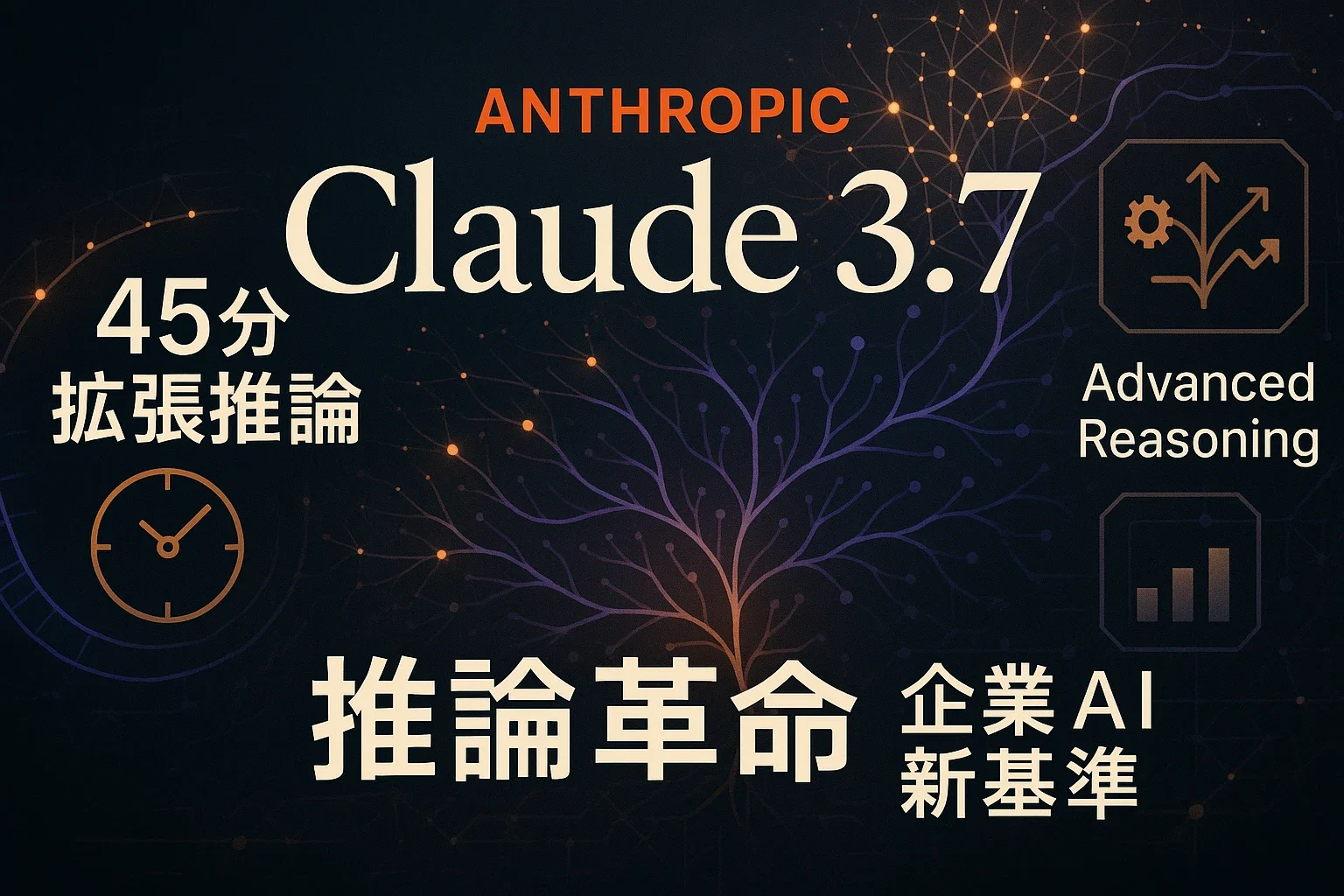
Anthropic Achieves Reasoning Revolution with Claude 3.7 - Strengthening Competitiveness through Extended Thinking Mode and Hybrid Reasoning
Anthropic announces Claude 3.7 Sonnet. As the industry's first hybrid reasoning model, it dramatically improves complex problem-solving capabilities through extended thinking mode and real-time thought visualization
On February 25, 2025, Anthropic announced the official release of Claude 3.7 Sonnet, establishing a new standard for reasoning capability competition in the AI industry. As the industry’s first hybrid reasoning model, it achieves complex problem-solving through extended thinking mode and real-time thought visualization1.
Industry’s First Hybrid Reasoning Model
Claude 3.7 Sonnet, as the industry’s first hybrid reasoning model, allows users to choose between standard mode and extended thinking mode. In extended thinking mode, users can adjust problem-solving thinking time through reasoning token budget settings.
The groundbreaking feature is the ability to visualize AI’s thinking process in real time. Users can observe each stage of problem-solving and understand the logic behind reaching conclusions.
In practical tests, while Claude 3.5 Sonnet couldn’t leave Pallet Town in a Pokemon game, Claude 3.7 progressed to defeating multiple gym leaders, demonstrating improved practical task processing capabilities.
Technical Specifications and Availability
Claude 3.7 is accessible through web, mobile, API, Amazon Bedrock, and Vertex AI. It’s available even for free users, with pricing at $3 per million input tokens and $15 per million output tokens. It supports maximum output of 128K tokens and has knowledge up to October 2024.
Differentiation from Competitors
Compared to OpenAI’s o3 model, Claude 3.7 has an advantage in thinking process transparency. While o3’s reasoning process is private, Claude 3.7 visualizes the thinking process in real time, improving accountability of results. Against Google’s Gemini 2.0, it differentiates through specialization in reasoning and analysis.
Anticipated Use Cases
In manufacturing, Claude 3.7’s logical reasoning capabilities could be applied to design process automation. In the financial and insurance sectors, its transparent reasoning process is well suited to risk analysis, while in legal fields, the ability to visualize the thinking process is expected to contribute to improving reliability in case law research and similar tasks.
Safety and Privacy
Anthropic adopts a “Constitutional AI” approach with Claude 3.7, clearly defining AI behavioral principles. For corporate data handling, it ensures confidential information safety through encryption and access control.
Future Outlook
Claude 3.7 is positioned as a pioneer in a new era of human-AI collaboration. The nature of knowledge work will be fundamentally transformed, with AI handling routine analytical tasks while humans can focus on more creative activities. This transformation is expected to improve productivity and strengthen competitiveness for Japanese companies.
Sources
- Claude 3.7 Sonnet and Claude Code - Anthropic Official Announcement
- Anthropic’s Claude 3.7 Sonnet hybrid reasoning model is now available in Amazon Bedrock - AWS Official Blog
- Claude 3.7 Sonnet Complete Guide: The First Hybrid Reasoning Model - Technical Analysis Article
Was this article helpful?
Thank you!
Received. Thank you!