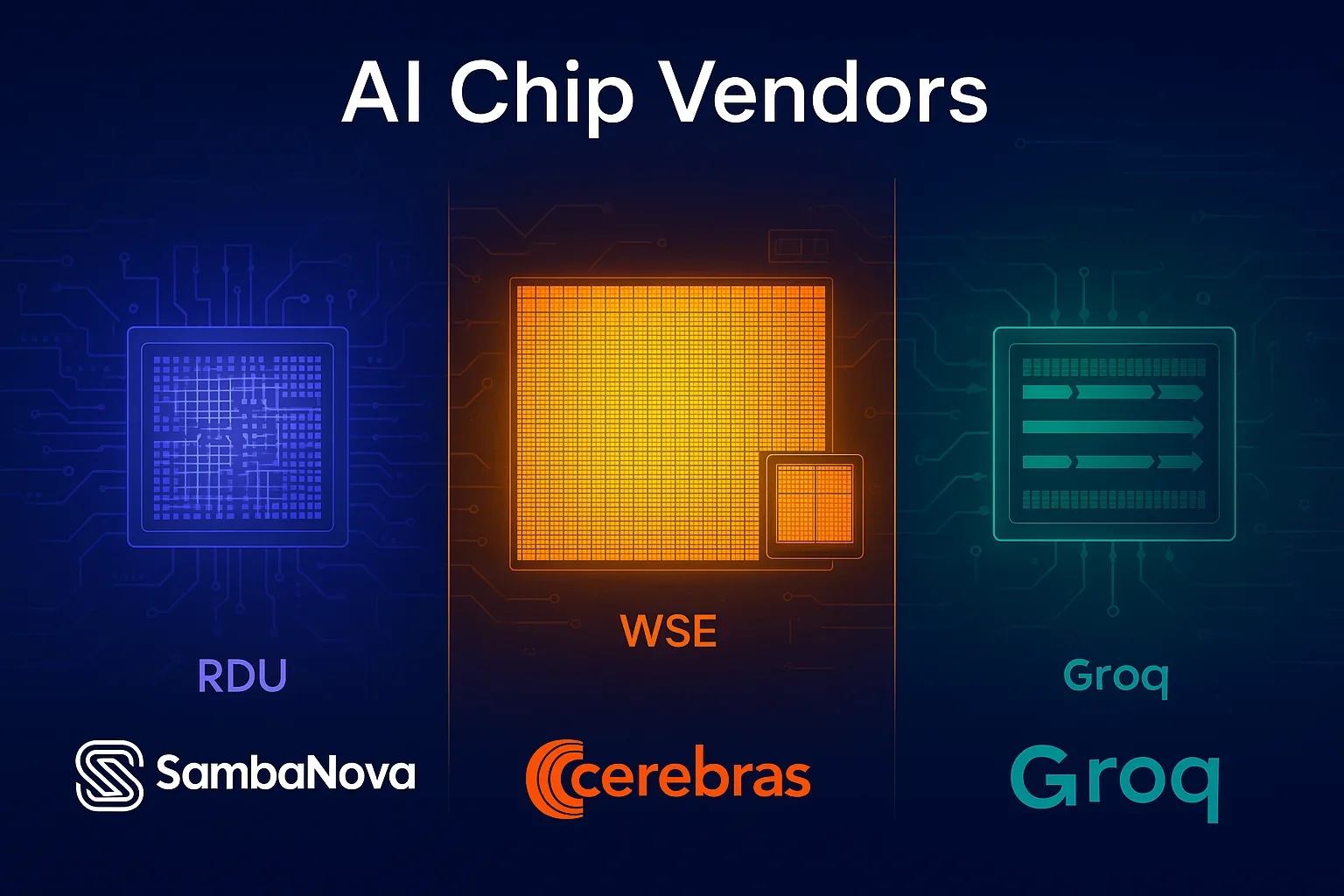
SambaNova vs Cerebras vs Groq: AI Chip Startups Challenging NVIDIA
How SambaNova, Cerebras, and Groq each rethink chip design for AI inference and training—dataflow (RDU), wafer-scale, and LPU architectures—and why they offer alternatives to NVIDIA GPUs.
Update, September 9, 2026: The comparison below reflects August 2025. Over the following year the standing of all three companies changed substantially. Groq continues to exist as an independent company, but NVIDIA acquired Groq’s assets under what Groq characterizes as a non-exclusive license, and the result has been commercialized as NVIDIA Groq 3 LPX, whose full production NVIDIA announced on August 24, 2026. Groq itself went on to announce a $350 million Series A on August 17, 2026, with the proceeds earmarked for NVIDIA clusters. Cerebras listed on Nasdaq in May 2026 (ticker CBRS, IPO price $185), opening at roughly twice the offer price on day one20. It also supplies the “Ultrafast” tier of the OpenAI API. SambaNova raised $1 billion in July 2026 at an $11 billion valuation, with JPMorgan Chase adopting it for on-premises inference. The “which one should you pick” guidance below therefore cannot be used as-is for a decision today.
Ever felt like ChatGPT takes forever to respond? The truth is, much of that wait time comes down to chip design. Running AI on a GPU—a graphics card built for gaming—is like driving a Formula 1 car to the grocery store: fast, but not built for the job, so a lot of that power goes to waste.
The three companies profiled here are tackling this problem at the root by building machines designed purely for AI. Put simply, SambaNova is a “transforming robot,” Cerebras is a “brute-force giant,” and Groq is a “zero-waste sprinter”—each reinventing AI processing in its own way123.
SambaNova: The AI Chip That Bends Like a Transforming Robot
Why does chip “shape-shifting” matter?
“Run an image-generation model in the morning, then switch to a text model in the afternoon.” That’s the kind of flexibility SambaNova was built for. Founded in 2017 by Rodrigo Liang with Stanford professors Kunle Olukotun and Chris Ré, the company’s RDU (Reconfigurable Dataflow Unit) changes its internal structure on the fly depending on the workload, much like a transformer toy reshaping itself for a new purpose.
How does it “transform”?
Think of SambaNova’s chip as a box of LEGO bricks: the same pieces can be reassembled into a car one moment and an airplane the next.
The numbers:
- Memory capacity: up to 1.5TB (roughly the storage of 100 iPhone Pro Max phones)4
- Speed gain: 6.6x faster than GPUs
- Footprint: 19x smaller5
In other words, an AI system that once needed an entire office floor can now run in a single conference room.
What can it actually do?
Remarkable multitasking:
- Holds hundreds of AI models in memory simultaneously
- Switches between models in 0.000001 seconds (microseconds)
- 100x faster model switching than GPUs6
A concrete example: text generation like ChatGPT
- Typical ChatGPT: about 15 characters per second
- With SambaNova: more than 200 characters per second7
That’s fast enough to finish writing a report in the time it takes to order a coffee.
Cerebras: The World’s Largest Chip Solves Problems Through Brute Force
Why go giant?
The team of former AMD engineers who founded Cerebras in 2015 ran into a problem: “traffic jams” of data21. On a conventional chip, moving data between chips takes time—like cars backing up at a highway tollbooth.
Cerebras’s answer: “What if we put everything on one giant chip and eliminate the tollbooth entirely?”
Just how big is it?
Size comparison:
- Cerebras WSE-3: 21.5cm x 21.5cm (about the size of a tablet)
- A typical chip: 2cm x 2cm (about the size of a thumbnail)
- 56x larger than an NVIDIA H100, as reported by ServeTheHome9
What’s inside:
- Transistors: 4 trillion (40x the number of neurons in the human brain)8
- AI-dedicated cores: 900,000 (roughly the population of a small city)
- Memory bandwidth: 21 petabytes per second10
That’s fast enough to download every video on Netflix in a single second.
What can it actually do?
Blazing processing speed:
- ChatGPT-style text generation: 1,800 characters per second
- 20x faster than NVIDIA GPUs1112
- Power draw: 23kW (about as much as 8 average households)
Real-world deployments:
- Mayo Clinic: developing AI models for cancer research and drug discovery
- AlphaSense: accelerating financial-analysis AI
- Condor Galaxy 3: a supercomputer built from 64 linked units13
It’s especially well suited to workloads that need to crunch massive volumes of data at once.
Groq: The Zero-Waste Sprinter Built for Pure Speed
Why obsess over speed?
In 2016, Jonathan Ross—who had previously worked on Google’s TPU—grew frustrated with how much AI made users wait. “Why does it take a computer so long to think?”
His answer: build a 100-meter sprinter with zero wasted motion. The result was the LPU (Language Processing Unit).
How did Groq cut out the waste?
Think of it as a factory conveyor belt.
A typical GPU works like a restaurant kitchen, cooking each dish as orders come in. Groq’s LPU works like an assembly line, where every step runs in a fixed, predetermined order.
The results:
- Response time: under 0.001 seconds (faster than a blink)14
- Power efficiency: 10x better than GPUs151617
- Roughly a tenth of the electricity cost
What can it actually do?
Stunning speed: 13x faster than ChatGPT
- Typical ChatGPT: about 10 seconds to respond
- With Groq: responds in 0.7 seconds19
Practical benefits:
- Customer support: instant replies
- Live chat: response speed indistinguishable from a human
- Code completion: suggestions appear as you type
Companies using Groq: Dropbox, Vercel, Volkswagen, Canva, and others18
(At the time, a plan was described to expand to roughly 136x that capacity — 108,000 LPUs — by early 2025. The LPU technology has since also been productized on NVIDIA’s side, and progress against that plan has not been tracked here.)
Which One Should You Choose? A Simple Guide
If each company were a mode of transportation…
| Company | Analogy | Strength | Weakness | Best fit |
|---|---|---|---|---|
| SambaNova | Transforming robot / bus | Flexibility, multitasking | Higher upfront cost | Companies running multiple AI models |
| Cerebras | Giant cargo ship | Massive data processing | Physically huge | Research institutions, large enterprises |
| Groq | Formula 1 car | Unmatched speed | Not built for training | Real-time services |
Who should pick which?
Choose SambaNova if you:
- Offer multiple AI services
- Need to switch between image generation in the morning and text generation in the afternoon
- Want to stay flexible for whatever AI models come next
Choose Cerebras if you:
- Work with massive datasets in healthcare or finance
- Are building your own large-scale proprietary AI model
- Prioritize performance over power costs
Choose Groq if you:
- Run chatbots or real-time services
- Need response speed above all else
- Want to cut power costs dramatically
Looking ahead
Predictions for 2025 and beyond:
- Costs will fall, opening the door for small and mid-sized companies
- NVIDIA’s dominance will erode as more options emerge
- Each vendor will carve out its own specialized niche
Three years from now: A world where “ChatGPT replies in 0.1 seconds” and “large AI models run on your phone” may simply be the norm.
For readers who want to dig deeper into these AI chip vendors, here are each company’s official resources.
- SambaNova official site - Product details and architecture documentation
- Cerebras official blog - Details on the CS-3 system
- Groq Developer Portal - LPU performance benchmarks and API access
Sources
- SambaNova | The Fastest AI Inference Platform & Hardware - SambaNova Official Site
- Cerebras - Cerebras Official Site
- Groq is fast inference for AI builders - Groq Official Site
- SN40L RDU | Next-Gen AI Chip for Inference at Scale - SambaNova Chip Details
- SambaNova RDU, reconfigurable architectures for inference, training, and agentic AI - Medium Technical Article
- RDU: The GPU Alternative | SambaNova - RDU Technical Details
- SambaNova Unveils New AI Chip, the SN40L - Press Release
- Cerebras WSE-3: Third Generation Superchip for AI - IEEE Spectrum Article
- Cerebras WSE-3 AI Chip Launched 56x Larger than NVIDIA H100 - ServeTheHome Analysis
- Cerebras CS-3: the world’s fastest and most scalable AI accelerator - Cerebras Official Blog
- Cerebras’ Third-Gen Wafer-Scale Chip Doubles Performance - EE Times Article
- Cerebras WSE3 Versus Nvidia B200 - NextBigFuture Comparison
- Cerebras Goes Hyperscale With Third Gen Waferscale Supercomputers - The Next Platform
- The Architecture of Groq’s LPU - Technical Architecture Analysis
- What is a Language Processing Unit? - Groq Official Blog
- How Tensor Streaming Processor (TSP) forms the backend for LPU? - Medium Technical Article
- Supercharging LLM Training with Groq and LPUs - DEV Community
- What’s Groq AI and Everything About LPU 2025 - Voiceflow Analysis
- Groq’s ultrafast LPU accelerator smashes AI LLM benchmarks - 311 Institute
- Cerebras stock slides after near-70% surge in biggest IPO of 2026 - Yahoo Finance, Cerebras Nasdaq listing (May 15, 2026)
- Cerebras - Wikipedia - Cerebras founding year and founders (checked September 9, 2026)
Was this article helpful?
Thank you!
Received. Thank you!